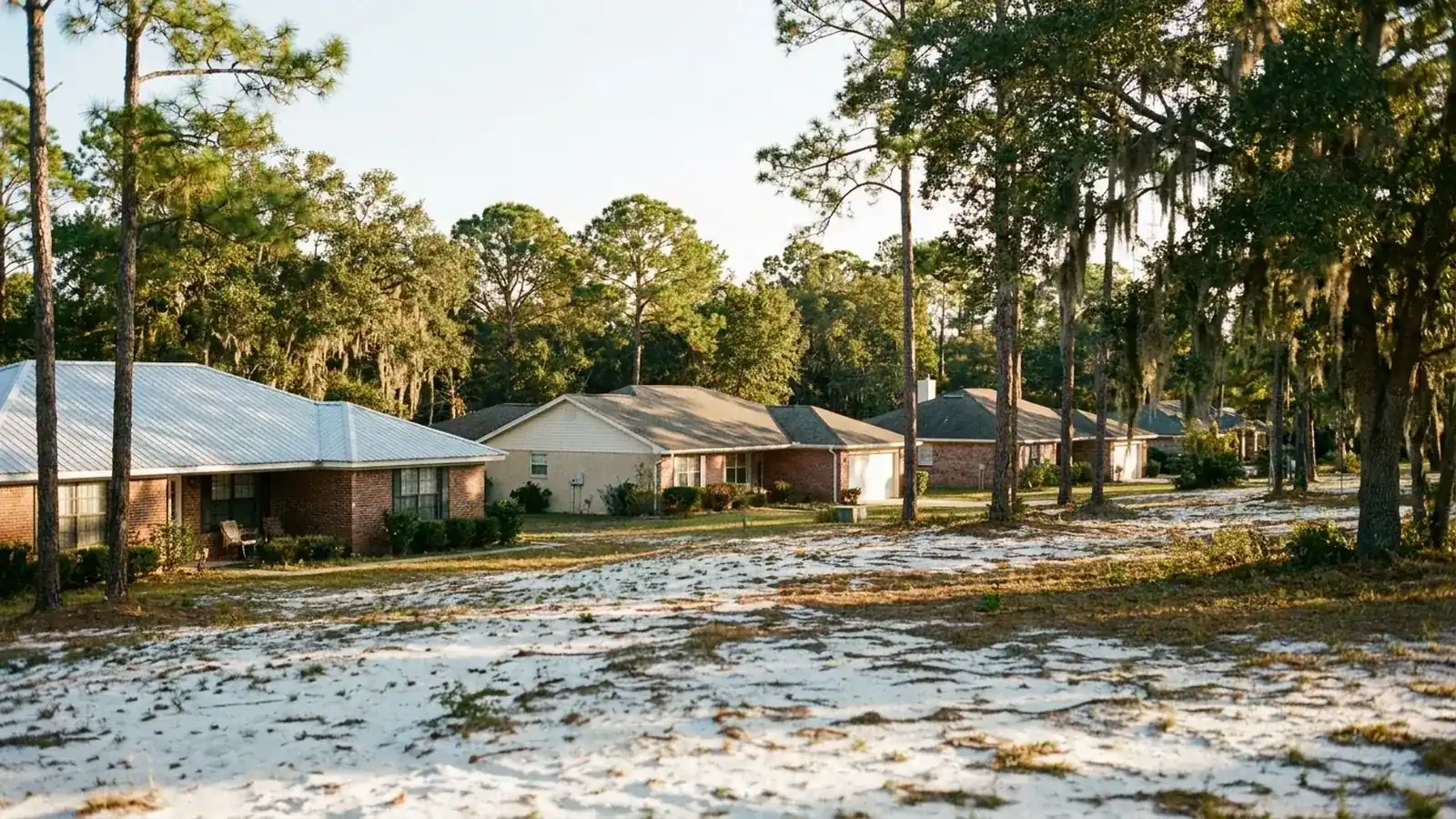
Helical piers in Pensacola cost $4,000–$15,000 for most full repairs, with piers commonly $1,200–$3,000 each. In sand that has washed out, a pier is passing through an absence rather than through weak material — and supporting the structure does not fill the void that water opened.
Why sand behaves differently from clay, what torque tells you in it, and why grouting usually belongs in the same scope.
Sand does not weaken, it leaves
Expansive clay loses strength and regains it as moisture cycles. Sand does not do that. Water moving through it carries the fine material away and opens voids, and nothing puts that material back — so what a pier is passing through is a space rather than a soft layer.
Torque readings still work, and in sand they are informative: the pier reports where it starts finding competent material again, which on a washed-out site is the number that matters.
How a helical pier differs from a driven one
A push pier is hydraulically driven into the ground using the weight of the building as the thing it pushes against, until it refuses on something firm. A helical pier is screwed in, and the torque required to turn it correlates with the capacity it will carry — so it reports what it has found as it goes rather than only at the end.
That difference decides which is right far more often than price does.
Why the void still needs filling
Carrying the structure past a void leaves the void. Water will keep using the path that created it, and the next extreme rainfall will find the same route. At 65.27 inches of rain a year — and after a day like 29 April 2014, when the city recorded 15.55 inches in a single calendar day — that is not a hypothetical.
So grouting is usually priced alongside the piers, and erosion control is what stops the sequence repeating. A scope with only one of the three is a scope that has answered part of the question.
And check which problem you have
Washout and sinkhole activity look alike from a doorframe and are treated differently by insurers. The coverage page covers what Florida policies do and do not include.
Helical piers, answered
What do helical piers cost in Pensacola?
$1,200–$3,000 per pier, most full repairs $4,000–$15,000. Where a void has opened, grouting is priced alongside rather than instead.
Do piers work in sand?
Piers work in sand. The helix bears in competent material below the disturbed zone, and the installation torque records where that material starts — which on a washed-out site is the useful number.
If the piers hold the house, why fill the void?
Because the void is the path water made, and water will use it again. Supporting the structure past it addresses the symptom and leaves the mechanism.
Is my problem a sinkhole?
Possibly not, and the difference matters for a claim. Washout and sinkhole activity look similar from inside but are distinct, and insurers treat them differently.
Is a helical pier the right tool for this ground?
Pensacola sand does not swell or shrink — it relocates. Water moving through it carries fines away and leaves voids, so the pier question here is really a void question.
| Option | What it does | On this ground specifically |
|---|---|---|
| Helical pier | Screwed in until the torque proves the capacity | Torque readings work well in sand and prove capacity below the disturbed zone |
| Push pier | Driven to refusal using the structure as ballast | Refusal in sand can be misleading — dense today, undermined by the next event |
| Pressed pilings | Precast sections pushed down and capped | Used regionally, with the same caution about what the tip is sitting above |
| Stabilise the soil | Manage moisture so the ground stops moving at all | Here this means void filling — replacing the material the water took |
Movement on this coast is event-driven, not seasonal: 15.55 inches fell in one day in 2014. After an event like that, filling what washed out matters as much as adding steel past it.
Book a free Pensacola foundation assessment
The most useful thing you can tell us is when it started, and whether anything happened around then — a named storm, a week of hard rain, a broken line, a neighbour regrading their lot. On sand, damage follows events rather than seasons, so a date is worth more here than a description. We reply the same working day.