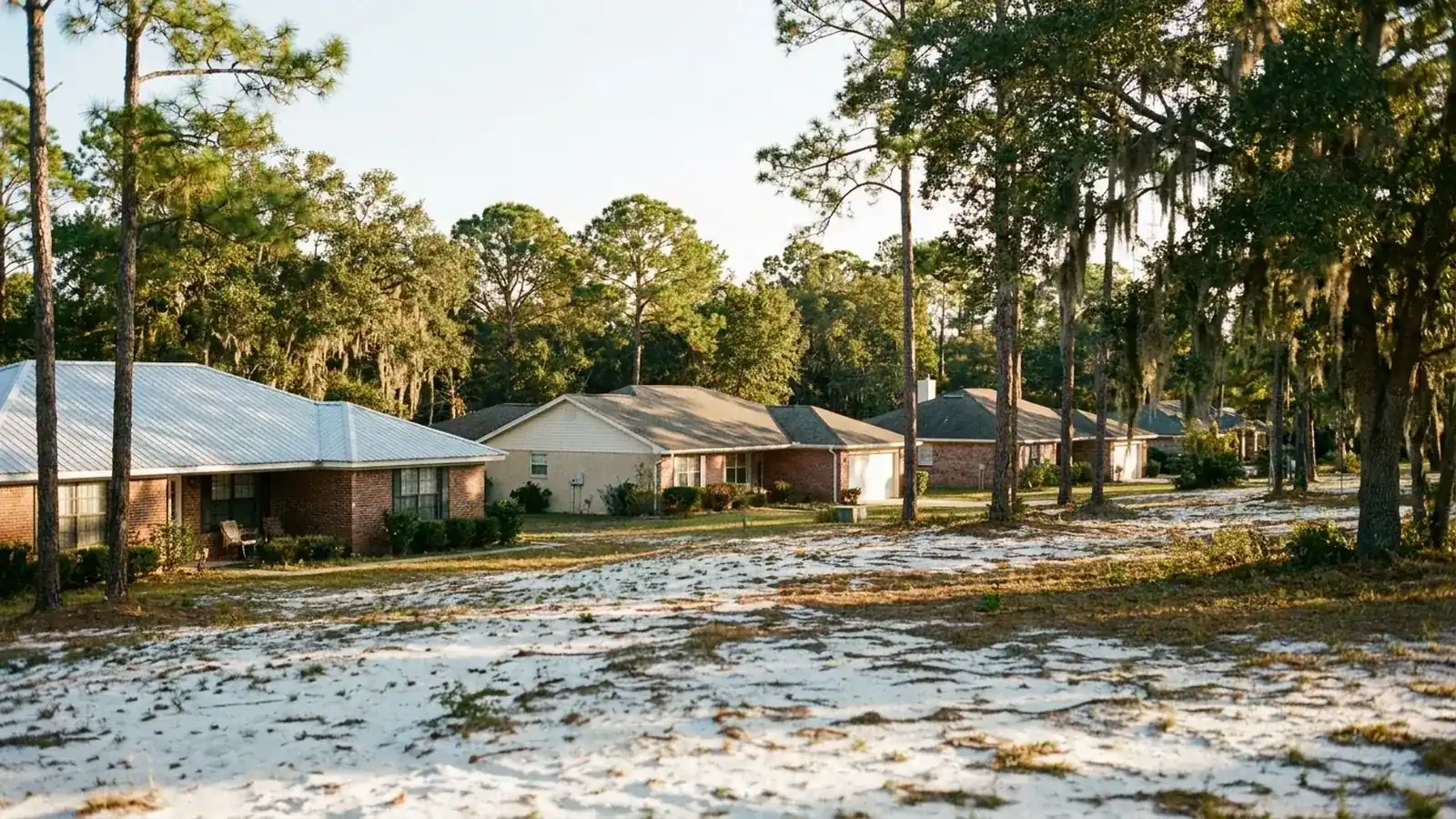
Foundation settlement repair in Pensacola runs $4,000–$15,000 for most full repairs, piers commonly $1,200–$3,000 each. The ground here is sand rather than clay, so movement is not seasonal swelling — it is material being carried away and leaving a void.
Why that makes damage event-driven, what filling a void adds to supporting through it, and the rainfall that does it.
Sand moves rather than swells
Expansive clay changes volume with moisture and produces damage that partly reverses between wet and dry seasons. Sand does not do that. Water moving through it carries the fine material away and opens voids beneath whatever was resting on it, and nothing puts that material back.
So settlement here is event-driven rather than seasonal. It appears after something specific rather than progressing through a year, and it does not improve on its own.
The events that do it
Pensacola takes 65.27 inches of precipitation a year, the wettest market on this batch. More to the point, it takes it in extraordinary bursts: on 29 April 2014 the city recorded 15.55 inches in a single calendar day, the greatest calendar-day total since records began in 1879, with roughly 20.47 inches over the event.
Hurricane Ivan in 2004 and Hurricane Sally in 2020 both made significant impact on this coast. Surge and extreme rainfall are what move sand, which is why a scope here starts by asking what happened and when.
Filling the void matters as much as supporting through it
Where the problem is an absence of material rather than unstable material, carrying the structure past the void is only half the repair. The void itself remains, and water will keep using the path that made it. Grouting addresses the space, piering addresses the support, and a scope here should usually price both and explain which is doing what.
Erosion control is the third line, and on a washout-driven site it is the one that decides whether it happens again.
Washout is not a sinkhole, and the difference matters
They look alike from a doorframe and they are not the same thing, particularly where insurance is involved. That distinction is worth reading before a claim, and the Florida coverage page covers what policies here do and do not include.
Settlement, answered plainly
What does settlement repair cost in Pensacola?
$4,000–$15,000 for most full repairs, piers commonly $1,200–$3,000 each. Where a void has opened, grouting is usually priced alongside the support rather than instead of it.
Why did it appear suddenly rather than gradually?
Because sand moves rather than swells. Damage here follows an event — extreme rainfall or surge — instead of progressing through a season. Pensacola recorded 15.55 inches in one day in April 2014, and that is the kind of event that does it.
Will it get better in the dry season?
It won't get better in the dry season. Clay damage partly reverses as the soil dries; washout damage does not, because the material that was supporting the footing has gone somewhere else.
Is this a sinkhole?
Possibly not, and the difference matters for a claim. Washout and sinkhole activity look similar from inside the house but are distinct, and the insurance treatment is not the same.
Is the movement finished, and what does that change?
Pensacola settlement is usually subtraction: sand does not swell or shrink, it leaves. An extreme rain event moves fines, opens a void, and the footing above it drops once.
| Option | What it does | What it means on this ground |
|---|---|---|
| Underpinning | Carries the load past the layer that is moving | Right where washout has left no dependable material within reach |
| Void filling | Replaces ground that washed or compressed away | Frequently the actual repair here — replace what the water removed |
| Moisture control | Ends the wet-dry cycling that drives the movement | Means routing storm water so the next event cannot repeat the theft |
| Monitor first | Establishes whether the movement is even active | Useful precisely because event damage stops — movement that continues is something else |
The temporal signature is the diagnostic on this coast: damage that arrived on a known date and stopped is washout. Damage that keeps creeping needs a different explanation before anyone opens a checkbook.
Book a free Pensacola foundation assessment
The most useful thing you can tell us is when it started, and whether anything happened around then — a named storm, a week of hard rain, a broken line, a neighbour regrading their lot. On sand, damage follows events rather than seasons, so a date is worth more here than a description. We reply the same working day.